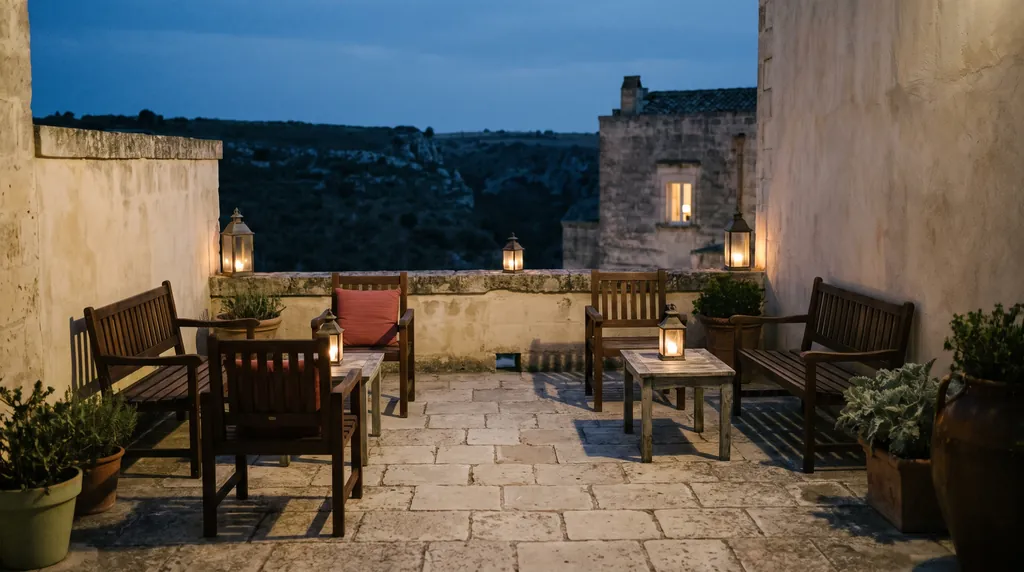

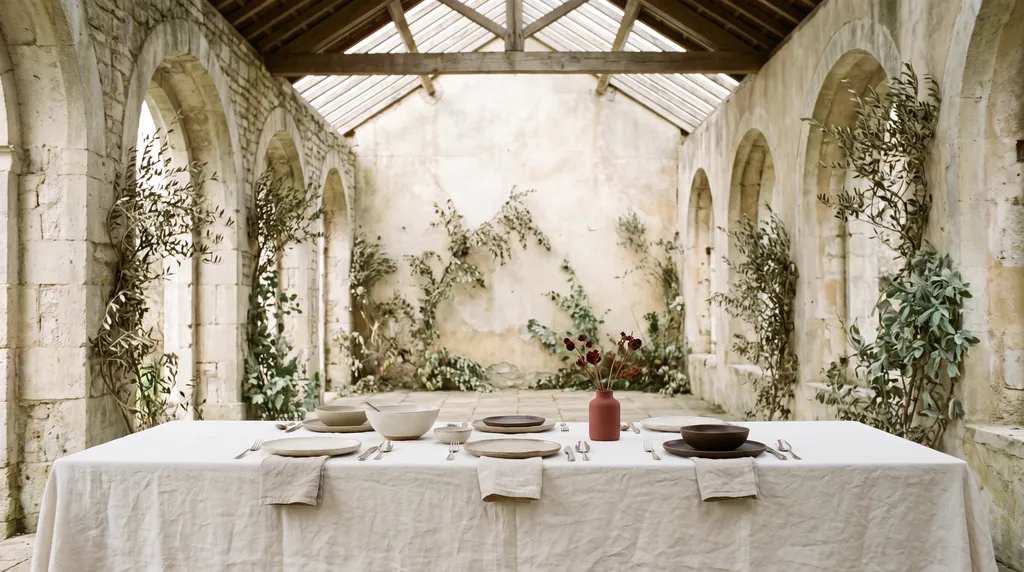
There is a moment, early in most projects, when someone opens a folder of images gathered over two years and says: this is what we want. The images are usually beautiful. They are also, almost always, from somewhere else. A garden in Tuscany, a loft in Copenhagen, a beach in Puglia. The work that follows is rarely about making those images real. It is about finding what, in this place, produces the same feeling.
A celebration that belongs to its setting is easy to recognise and hard to explain. Nothing looks imported. The colours agree with the stone. The dinner starts when the light is at its best, not when the schedule says so. Guests feel they have been let into somewhere rather than invited to a production.
The venue decides more than you think
Before the first sketch, a place has already answered a long list of questions. How many people can eat together without shouting. Whether the ceremony can be seen from the back. Where the sun will be at eight in the evening in late June. How far the kitchen is from the table, and therefore how hot the food will be. Whether the walk between the drinks and the dinner is a pleasure or an obligation.
Those answers are the real brief. Design that ignores them ends up fighting the building, and the guests feel the effort even if they cannot name it.
The most expensive mistakes are made in the first hour, when a place is chosen for a photograph rather than for a day.
Working with what is already there
The discipline is subtractive. A wall of eighteenth century plaster does not need to be covered. A row of plane trees does not need a structure underneath it. The design task is to bring in the few things that are genuinely missing: the right table height, the right light after sunset, a way for eighty people to sit down at once without the room feeling like a canteen.
This is also where restraint pays for itself. Money spent hiding a place is money that produces no memory. Money spent on the quality of what people touch, taste and hear tends to be remembered for years.
Three questions worth asking before signing
First, what does this place do better than any other on our list, and is that thing important to us. Second, what would we have to fight against here, and are we willing to pay for that fight. Third, what happens if the weather turns: not as an abstract worry, but as a plan with a drawing and a cost.
A venue that answers those three questions well is worth more than a venue that photographs well. In practice, the two are more often the same than people expect, once you know what to look for.
- Alain de Botton, The Architecture of Happiness, Hamish Hamilton, 2006.
- Christopher Alexander, A Pattern Language, Oxford University Press, 1977, on the design of places for gathering.
- Juhani Pallasmaa, The Eyes of the Skin: Architecture and the Senses, Wiley, 2005.